I want to make a high fantasy side project to fool around with when I’m a little burnt out of my main projects. Except I’m not really sure how to go about it. I’ve always been more of a paranormal romance and contemporary romance girlie and am not sure where to start.
How the heck are we all coming up with these names for things? Cities, countries, species, magic systems? Are they made up words that sound cool or based off existing things?
What order do these concepts come for you? Is it the world first? Or character concepts you build the world around? How do you make it come together?
How do you keep track of all this?
How much planning do you need before you feel comfortable starting?
I’ve never written high fantasy but someday I want to! Just because medieval Europe is so interesting to me. Although ancient Greece and other places and time periods would work very well with high fantasy too. I haven’t read the book Babel yet, but as I understand it, it takes place in Victorian China. Someday I’m going to have to read that thing since it’s been sitting on my kindle for years now.
As for character names, I use a site that catalogs actual medieval names that were in use from various documents of the time:
Right now I don’t have any ideas for a high fantasy novel, but I generally do world building as I write a book, so things in the world never exist until I have a need for them. Then I make a note of it for my worldbuilding folder.
Likewise I just create a character that’s the most ill-suited for the situation in order to create conflict and stakes.
Ideally I’d love to have a full outline before I start any project, but that never happens. I usually get frustrated trying to plan ahead, and so I just start writing it already to see where it goes and what occurs to me while I’m writing the darn thing. So I guess you could say I use a headlights outline…?
As for keeping track of everything, I was going to buy Scrivener once upon a time because it’s supposed to be good for that, but realistically I know I’d rarely use it. So I keep track of everything manually: I create a folder for the WIP, with folders inside that for Characters, Plot, Setting, Slang, Customs, Holidays, Cuisine, Fashion, etc. and just make notes inside those folders to keep track of the world.
Both! If I want to base my fantasy names off things, usually I’d pick a root language first (like Latin or Old English), use a translator to translate one word from English to that language, then change a couple letters here and there.
Other times I just have a good idea of the kind of sound I want my fantasy names to have, and make up a new name based off vibes.
I’m probably the least reliable source for this, but I just daydream really hard and see which daydream concepts work the best for this story. Or I steal inspiration from my dreams.
I first start out with a plot. Once I have the plot figured out, then I set the scene and the characters. I feel like I don’t go much into character depth until later in the process? Then again, it doesn’t help that my characters often act “independently” when I actually write them and sometimes steer the story in their own direction regardless of what I’ve already outlined ¯_(ツ)_/¯
As for making it all come together, I let it happen during the writing itself. Sometimes you learn more about your own world as you write. There are a bunch of things and concepts that I didn’t think of during the plotting phase that I ended up incorporating much later.
I would say my Word document dedicated to just story notes, except I’m not the best at updating it but when I think of something I like to put some notes somewhere. Like in a private Discord server or thread.
I can’t quantify it, but I’d say enough planning to know how the plot will end and also have a firm enough grasp on the setting and stuff. That’d usually be about a few months’ worth of planning alone.
Sometimes, it’s whatever I sound out randomly but usually I mash up words using one or two languages. So, for example, if I have a cold, snowy place to name, I might take the word “ice” and translate it into two different languages and then use what the pronunciations sound like to then come up with a name for a thing.
I might mix the pronunciations, too.
It’s rarely a direct translation which means only I will know the hidden meaning behind the name
But sometimes it’s just English Sometimes shadow magick is just shadow magick. Keeping it simple.
I write character-driven stories, so the character comes first. And since I’m a pantser, I discover the world as I write and edit.
Actually, you might find this interesting
This goes into what it’s like for me to write a fantasy novel especially around world building.
The same way as @stella_vigo
I have notes documents in WORD for each story and I’m not always good at remembering to update them either But I’m trying to be better at that because I suffer later on XD
I’m a pantser, but I do have a vague beginning, middle, and end in mind. I write towards the end, so I do come up with a pretty solid ending. I also fill my head with aesthetics for the story, so I’m prepared to write it. Oh, and I come up with a character name and a little bit about them. But that’s all I do beforehand.
Some info is old, some info is missing, and there’s at least one or two names that I changed the spelling of a few times in the story because I forgot to check my notes. Then I’m left with trying to figure out which one to use
The best starting point for me was to read/watch a lot of things I liked and think about what I finds worked or didn’t work in it. Good romance is extremely subjective. Cheesey romance also extremely preference based. At the end of the day all that matters is you personally enjoy it.
Another thing is building these characters to compliment something wrong with the other. Have them make each other rethink bad beliefs or past stuff, or just trigger bad personality traits in each other.
If person A has a really bad temper maybe person B is so cool headed about stuff it pisses person A off and pushes them to try to be better. Not for the other person but because its triggering to themselves.
Or B has always had to be super independent but A is a caretaker type and make B learn to rely on others.
Small stuff that compliments/aggravates your protagonist’s main conflict
Slow burn I think it’s important to think of it more of building a close friendship until they realize there’s something starting. If it’s enemies to lovers they’ll probably not be happy about it and get weird and slowly come around to it. In those cases normally someone has definitely fallen first and depending on who will affect how smooth it goes from there.
I approach worldbuilding with a sort of archeologist/sociologist perspective, so this honestly might not be good advice for someone looking to relax their brain from their main project. Fantasy can be really difficult to work through, because it requires inventing rules and then following those rules.
That said, if you need advice what might be helpful is knowing about soft worldbuilding–and likewise soft magic systems and hard magic systems.
Soft Worldbuilding/Magic Systems
Vibe based, baby. These worlds/magic system often add texture to the story, encompass the overall feel of the story, and add to the narrative “mood setting” if you will. Shit just happens, the world is the way it is, and nothing is really questioned. These magic systems/world tend to encompass an idea and concept more then it is logically set in stone. Good examples is Studio Ghibli, and Diana Wynne Jones (Howl’s Moving Castle). Really fantastic.
Hard Worldbuilding/Magic Systems
Intense. Shit’s really detailed, everything has a reason, a place, an understanding. Author’s will have novels-worth of backstory/background on how their magic systems work, the logic of their world, the details of history of this world. Everything is locked down, it’s really logical and intense. Examples would be Tolkien’s LOTR’s and Misborn. Equally as great, but a lot more logic-flowing and takes a long time to build. Might not be your cup of tea if you’re wanting to ease-up after facing burnout.
That being said, this is what I do:
I personally have names that differentiate regionally. Once I come up with a naming-system that fits that region, inventing names (character or even place names) for that specific region narrows down the search. To do this, I usually look up etymology (which helps for inventing words, this is actually useful because people can use context-clues of similar sounding words to decode what it means… sometimes) or I ground it in my invented pantheon, because my world’s pretty religious. I have a whole “Lore Bible” and “World Bible” that lists different places and names of places that might be typical of specific regions.
I have a very intense process. I have an idea of a world, a concept for a system, and overall have a brief summary of the goals I want to achieve with my world. However, I don’t always ground every detail 100%. Instead, what I do, is I write pretty long backstories for every single character (which helps round out my story especially if they’re from differencing socioeconomical backgrounds, but is also something I might not recommend as my backstories for each character are literally mini-novellas by the time I’m through with them). Because I have an idea of lore, whenever something in their backstory comes up, I invent it on the spot–then hard-lock it into my lore (write that shit down elsewhere for later and easier reference). If something needs refining later, I go back and add details, change details, etc. I’ve noticed this helps me follow the logic of my world a lot easier, because the real worldbuilding is happening during character-writing from people who live there. So, it makes it easier to conceptualize or fathom.
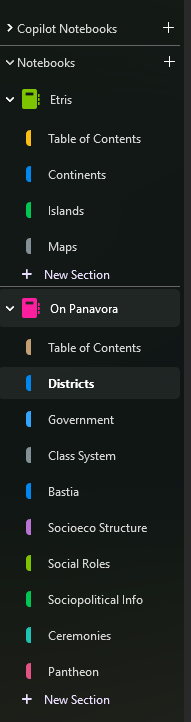
Lots of different apps. Right now, I’m using One-Note and have structured it to be a personal wiki for quick access (you can add hyperlinks to other parts of the One-Note as reference to different things, an index that takes you directly to what you need, and different tabs that explain different things). Here’s a screenshot of that:
I’m both a planner and a pantser who is character-driven. I know exactly which way my characters need to develop psychologically for the actual planning of the story to be fulfilled. I, essentially, have a bullet pointed list of the content each book is meant to contain–and some chapters hard-plotted if something specific has to happen. However, a lot of the time I have an “idea” for what I want to do, but don’t strictly follow the “outline” just let myself write. This helps me both maintain continuity (because there’s a real plan and goal and structure) and it also gives me more freedom to write my characters and scenes in a way that’s instinctual. I trust myself and my instincts a lot, so when something’s not jiving, I sit on that shit for a day or two and figure out what’s the matter before moving on. Sometimes that’s changing literally one sentence, sometimes it means scrapping and rewriting the whole thing.
However, I do hard-lock many of the socio-factors before writing, and I take time to develop after I’ve cemented something as canon so that everything is in place and air-tight. But I am also extremely obsessed, lmao.

 but when I think of something I like to put some notes somewhere. Like in a private Discord server or thread.
 Sometimes shadow magick is just shadow magick. Keeping it simple.