Ah, yes, about that: I’ve been trying to understand the difference between how hard signs and soft signs in Russian work for a while now, but it’s proving difficult. So that’s something I really want to look into. So any more help is appreciated, especially when I start learning Russian properly.
Right now I can only like half-read Cyrillic and know some basic words like спасибо or мой друг.
And once I learn the difference, I can implement the same in Alendi. For now, though, I’m using Ъ as a substitute for Y.
Now, onto Alendi:
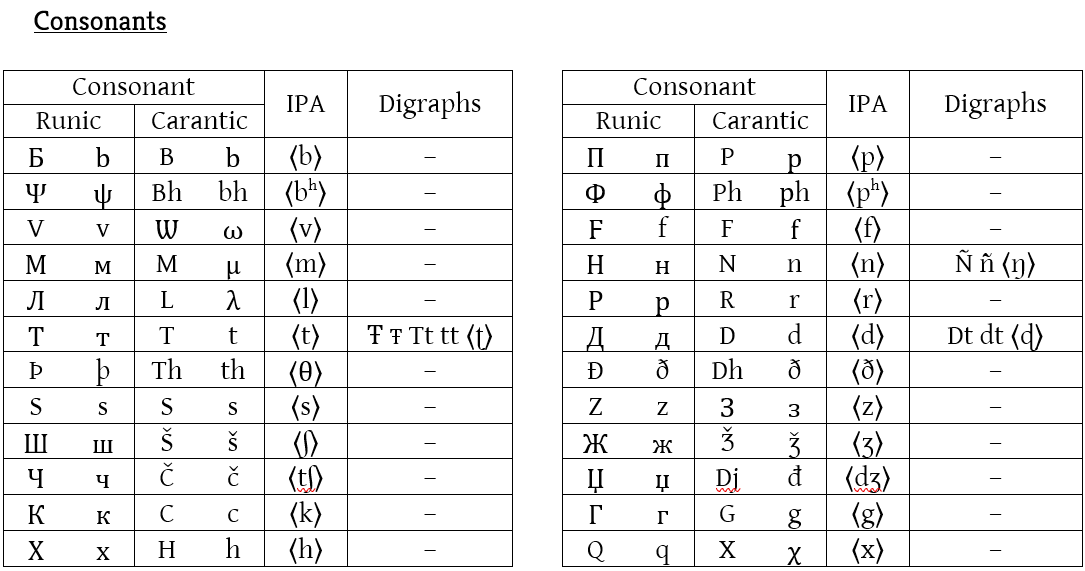
Alendi has six vowels: A, E, I, O, U, and Y. I imagine their Runic variants can be А, Е, И, О, Y, Ъ, not because it’s faithful to its sources, but because it’s easier to carve. Actually, for the letter Y, I’m not sure whether to use Ъ, Ь or Ы. I’m just wondering what will be easier to carve. Or maybe I should get letters of my own.
Furthermore, they have accented variants: á, é, í, ó, ú, ý. They are sometimes there in Runic, but generally not present. Depending on the time period, the accent modifies the letter somehow (o = hotel, ó = hot), or tells the reader which part of the word to stress. Alendi usually has an alternating stress pattern, where every alternate syllable is stressed, so the accents control which part of the word is stressed.
There are also umlauts and ogoneks: (ä, ë, ï, ö, ü, ÿ) or (ą, ę, į, ǫ, ų, y̨), the former adds a Y to the start, so you have YA, YE, YI, YO, YU and YY. And the latter add a nasal element to the end of the vowel.
Wow. I used that to mean ‘to see/perceive’.
 ahhh
ahhh
 because everyone always knows when lunch is anyway!